
The Fate of Women in the Camp System
The Zone of InterestThis thread follows women’s exploitation through forced labor, medical experimentation, racial classification, and the limited forms of care offered by other prisoners.
increasing Bearing strength in each event
 decreasing
Bearing strength in each eventdecreasingWomen as Labor and Property
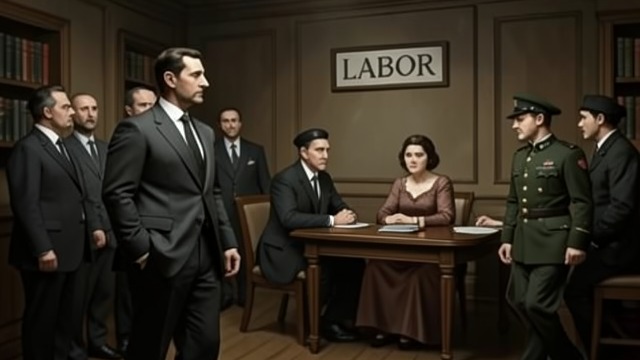
Women as Labor and Property
Labor demand expands
Officials discuss using women in factories as Germany faces manpower shortages. Their debate treats women as a resource to be mobilized rather than as people with choices.
Ideology sets unequal limits
Paul Doll rejects the idea of turning his wife into a worker even while accepting the exploitation of imprisoned women. The distinction shows how gender and status determine whose labor is considered acceptable.
Bayer’s Deadly Experiment

Bayer’s Deadly Experiment
A group of women dies
A Bayer letter reports that 150 women died during anesthetic tests and asks for a replacement group. The request is expressed as an administrative matter of supply and price.
Medicine becomes an instrument
The experiment’s failure does not stop the company from seeking more prisoners. The episode shows how medical authority and corporate research can be absorbed into the camp’s exploitation system.
Women in Medical Blocks

Women in Medical Blocks
Bodies become experimental material
The novel describes forced reproductive experiments and procedures in Block 10, alongside medical work in the SS-Hygienic Institute. Prisoner doctors operate under supervision and coercion.
Professional skill is captured
Some prisoners continue medical work in conditions far removed from freely chosen care. Their knowledge is used within an institution that denies their patients control over their own bodies.
Miriam’s Coerced Choice

Miriam’s Coerced Choice
An imprisoned doctor is recruited
Paul Doll orders Miriam Luxemburg to perform an abortion on Alisz and raises the possibility of making it fatal. He offers cigarettes and implies further rewards while withholding key information.
Consent is shaped by survival
Miriam asks whether the procedure can be changed and eventually agrees to act. Her professional decision takes place under extreme coercion, with her brother’s survival also used as leverage.
Care Inside a Killing Institution

Care Inside a Killing Institution
A prisoner survives a procedure
Alisz undergoes the abortion arranged by Doll and recovers from the immediate operation. Her continued survival depends on the same commandant who has exploited and confined her.
Care cannot redeem the system
The actions of prisoner doctors and individual helpers may reduce harm, but the camp determines the conditions in which care occurs. The novel holds both facts together without calling the arrangement humane.
Autumn 1942, during the camp’s industrial planning
Autumn 1942, when Burckl shows Thomsen the letter
Autumn 1942, during Thomsen’s account of the camps
Early 1943, before Alisz’s abortion
After Alisz’s procedure, early 1943
